Once Upon a Time… in Hollywood

Quentin Tarantino’s latest film, Once Upon a Time… in Hollywood, has received mixed reviews both among critics and within my social group. Its detractors argue that it meanders over its two-and-a-half-hour duration, and one person I spoke to described it as “a lot about nothing”. However, having seen it at the cinema this week, I have to say I disagree. It’s different to the director’s other films, sure, but it’s got a lot going for it.

Once Upon a Time… is to Tarantino’s other movies what Better Call Saul is to Breaking Bad. It’s slower than, say, Pulp Fiction, and spends a lot more time scene-setting between action sequences (which take both physical and emotional form). This is augmented with frequent blasts of the film’s glorious 1960s soundtrack, which I’ve been listening to on Spotify in the days since the screening. The visuals are also gorgeous – particularly some of the driving scenes and the later shots that linger on Los Angeles’ neon lights.

Cliff Booth (Brad Pitt) and Rick Dalton (Leonardo Di Caprio) show us their coolest stares

That said, it’s the characters that really make the movie. The dynamic between Di Caprio’s washed-up Western star and Pitt, his stuntman, is so successfully executed that you stick with them even through some of their darker moments, and I’ll be the first to admit my emotions were caught up in the drama when their relationship was put under some strain later on. And Di Caprio has some especially hard-hitting moments as his character Rick Dalton realises his career – and by extension his life – may have already passed its peak.

All the components of Once Upon a Time… add up to something greater than the sum of its parts. A film about a mopey Western actor might not sound the most engrossing, but when combined with stellar acting, beautiful cinematography, a carefree ’60s soundtrack, and a sprinkling of takes on famous faces from the era, Tarantino’s latest really makes you feel a part of its setting, and provides a near-perfect couple of hours of cinema escapism.
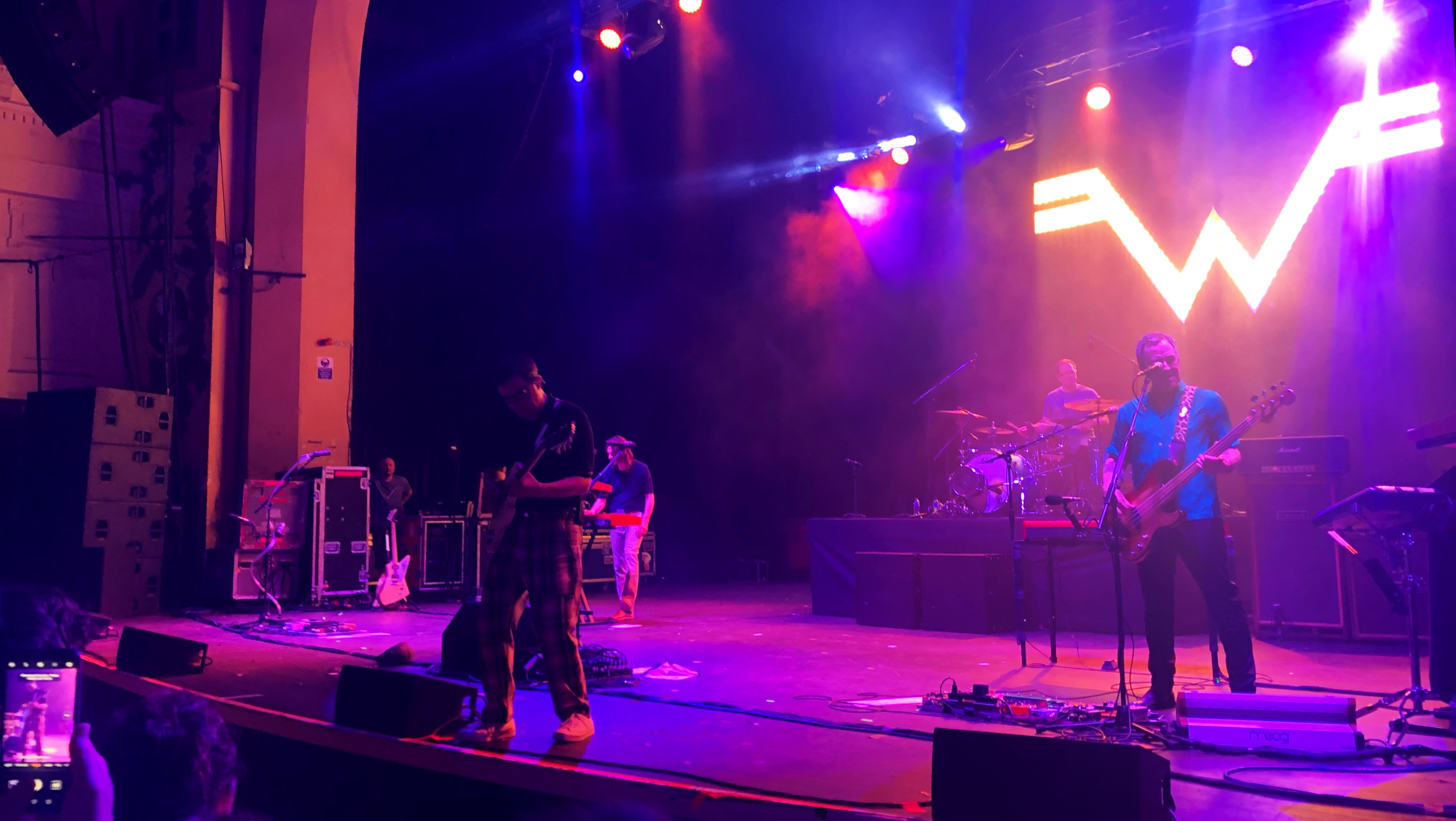
Weezer at Brixton Academy

I’ll be honest: when Rivers Cuomo took to the stage and Weezer launched into their 1994 single Buddy Holly, I was a bit worried. The frontman’s choice of outfit and the way he handled himself reminded me more of Johnny Knoxville’s bad grandpa character than the lovesick poet of songs like Across the Sea, and I thought I might be in for a long night.

How wrong I was! With the formality of the band’s biggest hit out of the way, what followed was mainly a mix of Blue Album (My Name Is Jonas, Undone – The Sweater Song, Surf Wax America, In The Garage) and Pinkerton (Why Bother?, El Scorcho, Pink Triangle, The Good Life) favourites that were belted out by band and fans alike.

Weezer on stage at Brixton Academy (missing: Rivers Cuomo’s old man hat)

Seriously, I don’t think I’ve ever been to a gig that was this much of a singalong – made possible by a perfect storm of beloved 1990s songs and covers from this year’s Teal Album (Happy Together, No Scrubs, Take On Me, and of course Africa) and culminating in a encore performance of Say It Ain’t So that saw the chorus yelled from every corner of the Brixton Academy. It’s safe to say very few people left early for the Tube.

By 11pm I was in a daze. This gig was hard work – the singing, jumping, and dancing didn’t stop during the band’s 90-minute set thanks to the constant stream of fan favourites. I was covered in sweat and, in all honesty, feeling a bit faint. London had hit 34 degrees during the day and throwing myself into a 1929 building full of Weezer fans wasn’t exactly the best way to cool down. But I can honestly say it was completely worth it.

Muse at the London Stadium

It’s difficult to know what to make of Muse’s gig at the London Stadium last night. Crowd management issues and a bland setlist might have left a sour taste in the mouth, but the band’s performance and the sheer scale and production value of the Simulation Theory Tour show were the main things I will remember from the evening.

You can’t deny that this show was one hell of a spectacle. Matt, Dom, and Chris were joined by a plethora of dancers, who did everything from firing smoke guns and abseiling up and down the stage’s LED screen in biohazard suits to commandeering giant metal exoskeletons. At one point Bellamy played a Simulation Theory-themed arcade machine, and the rock-heavy finale was invaded by a giant animatronic robot.

Giant robot Murph overshadows the Teignmouth trio

The setlist featured most of the Simulation Theory songs you’d expect – Algorithm, The Dark Side, Propaganda, Break It To Me, and the superior acoustic gospel version of Dig Down – alongside a selection of Muse’s greatest hits – Supermassive Black Hole, Starlight, Hysteria – and one or two surprises in the form of Bliss and Take A Bow.

There were a few heavier songs, including Stockholm Syndrome and New Born, but their lengths were significantly cut, and anything more obscure was relegated to the group’s “metal medley” – fans around me seemed just as disappointed when favourites like Assassin and Futurism were cut off just as they were getting going.

But this is the reality of a Muse album tour gig in 2019, I suppose. Fans like me who hope for older rarities are probably better off going to one of their smaller, rarer charity shows (if you can get a ticket). The other bonus to those gigs is that you won’t have to deal with the mess that was the London Stadium’s non-existent queueing system, the clueless stadium island staff, and the hour-long queue for the post-gig Tube home.