Funny Girl

I read a lot of Nick Hornby growing up. I sped through High Fidelity, About A Boy, and many more in my late teens, from which I have a very clear memory of a pretty girl who studied at a better university than me and smoked cigarettes laughing at my preferences and telling me to read Kafka instead. When I saw Funny Girl in a local charity shop, then, I thought it was a good chance to see how far my tastes have matured in the last decade.

One thing’s for sure: Hornby can still write a book I can’t put down. Published four years ago, Funny Girl tracks the life of a Blackpool woman who moves to London to pursue a career in television acting. From there, the writers, producer, and other actors on her big-break television programme enter the story, and the bulk of the book is an ensemble effort with all kinds of plot threads progressing simultaneously on everything from gay rights to the north-south divide, all tied together by Hornby’s trademark sharp dialogue.

The half-bottle of whisky alone already makes this photo darker than any part of Funny Girl.

But while this was enough to keep the pages turning, as I reached the end I couldn’t help but think it was all a bit easy. Main character Sophie moves to London and finds a sketchy agent – but she lands her dream job by herself and pretty much lives happily ever after. Relationships end – amicably. Characters take risks with their careers – and they pay off. I never felt that there was anything at stake once the first episode of Sophie’s sitcom proved a hit, and even if there had been, the show’s team were too tight-knit a group for it to matter. Even internal affairs and cheating had no noticeable effect on their dynamic.

Maybe it’s just a sign of where I’m at when it comes to reading. An entertaining story might have been enough to keep me going in 2008 (or as some light relief after the heavy, philosophical 12 Rules for Life), but I’ve read too many novels since that have left me with that “wow” feeling as I turned the final page, having offered a new perspective on the world and given me some thinking to do beyond the surface-level plot. Funny Girl had none of that, but was so fast-paced and well-written that I flew through its pages anyway.
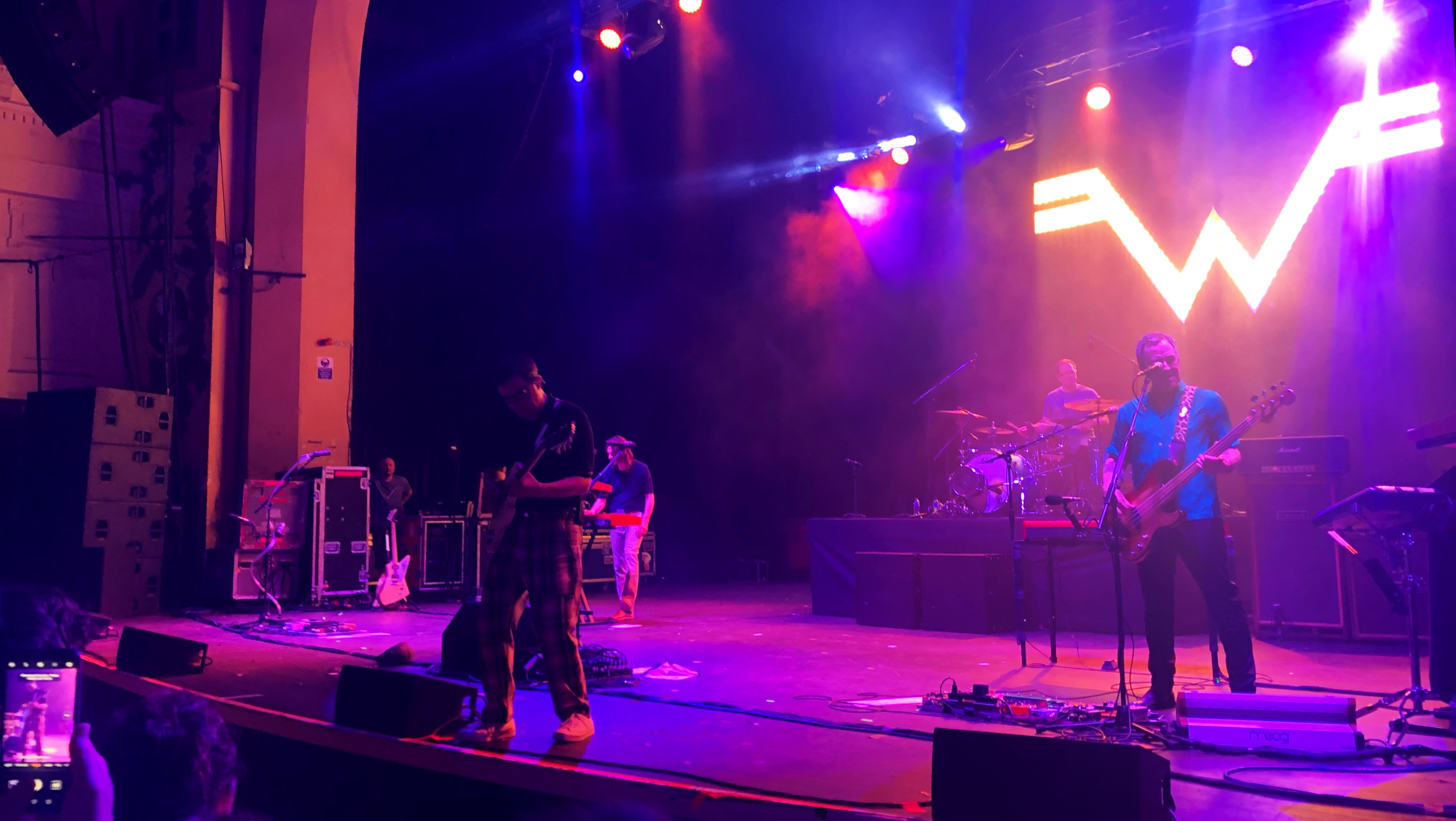
Weezer at Brixton Academy

I’ll be honest: when Rivers Cuomo took to the stage and Weezer launched into their 1994 single Buddy Holly, I was a bit worried. The frontman’s choice of outfit and the way he handled himself reminded me more of Johnny Knoxville’s bad grandpa character than the lovesick poet of songs like Across the Sea, and I thought I might be in for a long night.

How wrong I was! With the formality of the band’s biggest hit out of the way, what followed was mainly a mix of Blue Album (My Name Is Jonas, Undone – The Sweater Song, Surf Wax America, In The Garage) and Pinkerton (Why Bother?, El Scorcho, Pink Triangle, The Good Life) favourites that were belted out by band and fans alike.

Weezer on stage at Brixton Academy (missing: Rivers Cuomo’s old man hat)

Seriously, I don’t think I’ve ever been to a gig that was this much of a singalong – made possible by a perfect storm of beloved 1990s songs and covers from this year’s Teal Album (Happy Together, No Scrubs, Take On Me, and of course Africa) and culminating in a encore performance of Say It Ain’t So that saw the chorus yelled from every corner of the Brixton Academy. It’s safe to say very few people left early for the Tube.

By 11pm I was in a daze. This gig was hard work – the singing, jumping, and dancing didn’t stop during the band’s 90-minute set thanks to the constant stream of fan favourites. I was covered in sweat and, in all honesty, feeling a bit faint. London had hit 34 degrees during the day and throwing myself into a 1929 building full of Weezer fans wasn’t exactly the best way to cool down. But I can honestly say it was completely worth it.

Muse at the London Stadium

It’s difficult to know what to make of Muse’s gig at the London Stadium last night. Crowd management issues and a bland setlist might have left a sour taste in the mouth, but the band’s performance and the sheer scale and production value of the Simulation Theory Tour show were the main things I will remember from the evening.

You can’t deny that this show was one hell of a spectacle. Matt, Dom, and Chris were joined by a plethora of dancers, who did everything from firing smoke guns and abseiling up and down the stage’s LED screen in biohazard suits to commandeering giant metal exoskeletons. At one point Bellamy played a Simulation Theory-themed arcade machine, and the rock-heavy finale was invaded by a giant animatronic robot.

Giant robot Murph overshadows the Teignmouth trio

The setlist featured most of the Simulation Theory songs you’d expect – Algorithm, The Dark Side, Propaganda, Break It To Me, and the superior acoustic gospel version of Dig Down – alongside a selection of Muse’s greatest hits – Supermassive Black Hole, Starlight, Hysteria – and one or two surprises in the form of Bliss and Take A Bow.

There were a few heavier songs, including Stockholm Syndrome and New Born, but their lengths were significantly cut, and anything more obscure was relegated to the group’s “metal medley” – fans around me seemed just as disappointed when favourites like Assassin and Futurism were cut off just as they were getting going.

But this is the reality of a Muse album tour gig in 2019, I suppose. Fans like me who hope for older rarities are probably better off going to one of their smaller, rarer charity shows (if you can get a ticket). The other bonus to those gigs is that you won’t have to deal with the mess that was the London Stadium’s non-existent queueing system, the clueless stadium island staff, and the hour-long queue for the post-gig Tube home.